
Tinted glasses
November 5, 2026 | FashionWe get lots of questions about tinted glasses, which isn’t really surprising as they look incredibly stylish. Adding a subtle tint to the lenses usually gives glasses a bit more edge and makes them stand out a little. In this blog post, we’ll try to explain and answer the questions that tend to come up.
- A major trend
- What is gradual toning?
- Tinted glass – A true craft
- Colours – gradual toning
- Prescription tinted glasses
- Progressive glasses with tinted lenses
- Tinted glasses
- Colour-changing and tinted glass
- Advantages and disadvantages of tinted glasses
- Tinted glasses – light-sensitive
Tinted glasses – A major trend
A major trend in recent years has been chunky, slightly more pronounced frames. This type of frame looks incredibly good with tinted lenses. It can also be a really nice way to enhance a thin metal frame, transforming it in an instant into something very stylish and cool. A couple of years ago, I appeared on TV4’s ‘Nyhetsmorgon’ programme and spoke specifically about the trend for tinted and coloured lenses. Jenny Strömstedt tried on a number of frames with tinted or coloured lenses at the time. The clip is still available and is linked in a previous blog post (read more).
Gradual toning
When it comes to tinted lenses, most people mean lenses with a gradient tint. This means that the lens is slightly darker at the top and lighter at the bottom. Lightly tinted lenses with a gradient tint are the most commonly used for everyday glasses; they are darker at the top and fade gently to a lighter shade at the bottom. The tint is usually 30 per cent at the top and 0 per cent at the bottom, or 40 per cent–0 per cent, depending somewhat on personal taste, preference and the colour chosen. This is usually ideal if you’re looking for a pair of tinted glasses for indoor use as well. If you add more tint than that, they may appear a little too dark.
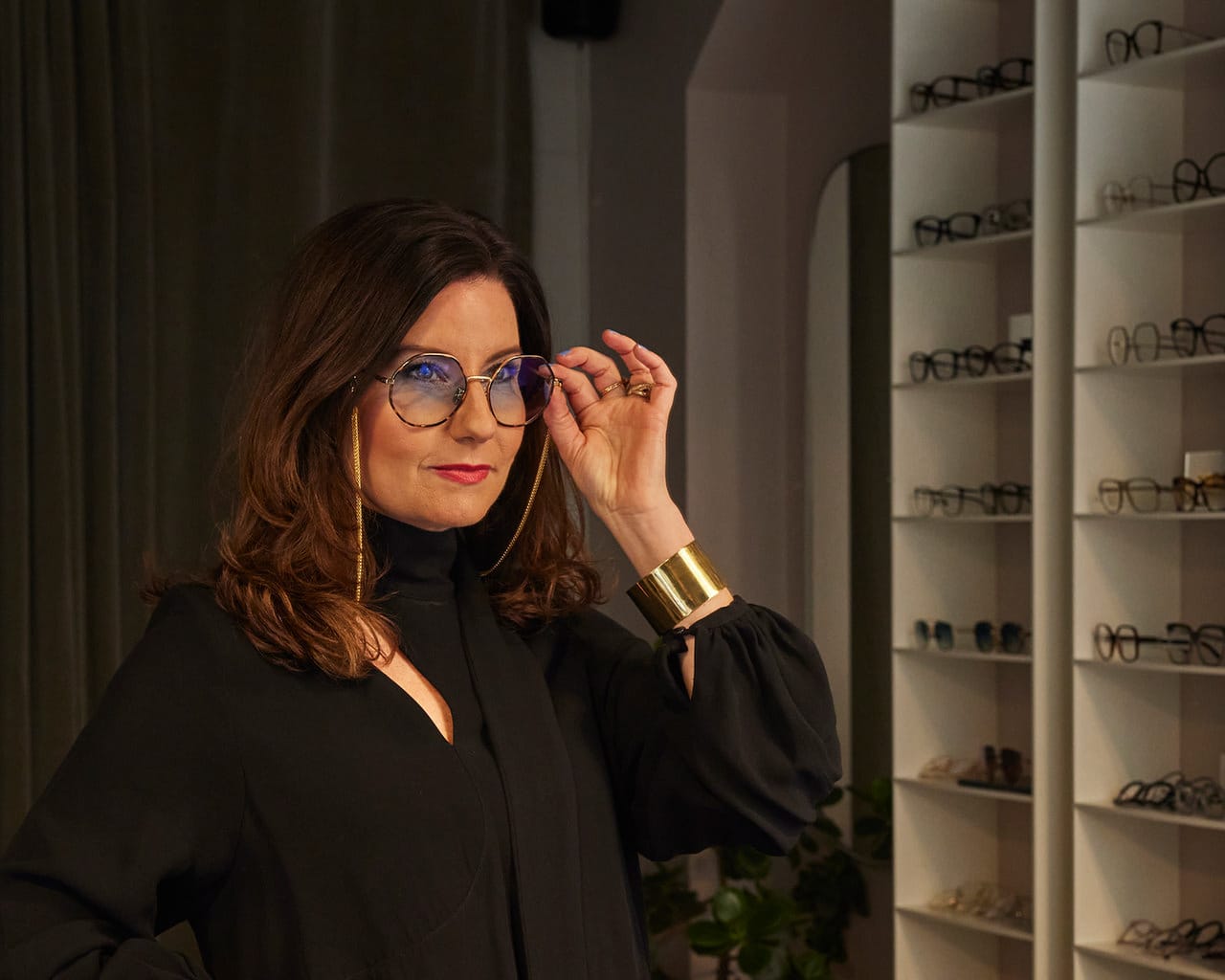
The advantage of gradient tinting is that the lenses are lighter at the bottom, which makes it easier to read, for example. The glasses I’m wearing in the top picture have blue lenses with 40%–0% gradient tinting. Emma (left) and Alexandra (right) in the picture below also have gradient-tinted lenses in their glasses, both with brown 40%–0% tinting.

Tinted glasses – A true craft
Colouring glass is a true craft, as different glass thicknesses, refractive indices and strengths all affect the end result. All glass is coloured by hand, something I also saw for myself during my most recent visit to one of our suppliers. This means that a person stands there dipping the glass into the various colour baths to achieve the perfect shade or colour for your particular piece of glass. Premium lenses also have 8–9 layers of surface treatment (anti-reflective, scratch-resistant, water-repellent, etc.) which need to dry before the next layer can be applied. All in all, there’s a great deal of work that goes into your new lenses. I’ll come back to the topic of how spectacle lenses are manufactured in a later post.
What colours can I choose from?
We have created our own colour chart in addition to the standard colours such as grey, brown and black. If, despite this, you still can’t find the colour you’ve got in mind, we can help you create a pair of completely unique glasses; we have over 80 colour samples in our shops, and if that’s not enough, you can order your very own custom colour. Please get in touch with us and we’ll be happy to help.


Prescription tinted glasses
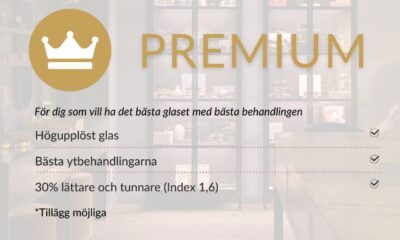
Most of the glasses we make with tinted lenses are, of course, prescription glasses. However, there are also those who see them more as an accessory, and we can also help with non-prescription tinted glasses. In our online shop, you can order glasses with tinted or coloured lenses just as easily as a pair with clear lenses. Simply click on the ‘Add lenses’ button right next to the frame you’ve chosen. The option to choose a colour is available for our premium lenses.
-
 Premium279,00€
Can you have varifocals with tinted lenses?
Of course, we can help with tinted lenses for your varifocals. Varifocals are customised to suit the wearer to ensure a good fit, which means that, unfortunately, we cannot sell them online. We’re simply committed to ensuring they’re just right. You can choose from the same colours as for single-vision lenses. So there’s no difference there.

Tinted glasses
Tinted spectacle lenses with the same colour across the entire lens have also become popular in recent years. We see many celebrities, such as Johnny Depp and Benjamin Ingrosso, who like to choose colours that stand out a little – ranging from blue to yellow lenses – though there are, of course, many shades to choose from. Depending on the colour, the tint is often set at between 30–50 per cent. As a reference, sunglasses typically have a tint of around 85 per cent.
After one of the segments on TV4’s *Nyhetsmorgon*, I received lots of questions about my pink lenses. They’re a pair of solid-coloured pink lenses (40%) that I’ve fitted into a pilot-style frame from Dior.
Examples of colours you can choose from when ordering solid-coloured glass online:


News – Colour-changing and tinted glass
Photochromic (Transitions) and tinted lenses are now also available. Previously, customers had to choose between lenses that darken in sunlight and those with a fixed tint. Now you can also choose a base tint and add the colour-changing function, which makes the glasses more comfortable to wear even in sunlight. These lenses can also be ordered from our online shop; simply select the premium lenses and you’ll then be able to choose the optional extras.
Advantages and disadvantages of tinted glasses or coloured lenses
The pros and cons of tinted or coloured glasses are not entirely straightforward, as it is up to the wearer to decide. Some people are very sensitive to them, whilst others hardly notice them. But let’s start with the slightly more obvious drawbacks. If you choose to have your lenses tinted or coloured, colours will be rendered differently. In other words, if you’re a designer, graphic designer or work in a profession where colour codes and precise colours are important, this is a poor choice. Many people therefore choose to have one pair of glasses with clear lenses for work and another stylish pair with tinted lenses for their private life. The advantages of tinted lenses are that you can customise your glasses so that they’re unique and suit your colour scheme and preferences. I always feel a bit cooler in tinted lenses and think they help make the glasses feel like an accessory.
Tinted glasses – light-sensitive
Tinted glasses are often seen as a positive solution for those who are sensitive to light. They help filter out some of the brightest light whilst providing a lighter area at the bottom, which can be helpful when reading, for example. How dark you choose the tint is largely up to the wearer; we usually recommend going from 30 to 0 or 40 to 0. There are also a variety of filter lenses available that block out some of the light which, for example, can trigger migraines or enhance contrast for those who need it. Lenses for migraines have a light pink tint, whilst contrast-enhancing lenses are yellow or orange.


Tinted lenses have a fixed colour or gradient tint. You choose a specific shade and strength, which remain constant. Photochromic (colour-changing) lenses, such as Transitions, change colour depending on light conditions. They darken outdoors and lighten indoors. The choice depends on your lifestyle and how often you move between different lighting environments. I’d also like to take this opportunity to recommend David’s blog post on colour-changing lenses, which outlines the pros and cons (https://hultinsoptik.se/varfor-jag-alskar-transitions/).
Absolutely. Tinted glass can be excellent at blocking UV radiation. It is not the colour itself that determines the level of protection, but the construction of the glass; even clear glass can offer some protection against UV.
Gradient-tinted glass is darker at the top and gets lighter towards the bottom. This creates a soft and stylish transition. It’s on-trend and works well for everyday use or more subtle sun protection. Solid-coloured lenses provide a uniform shade across the entire lens, offering greater visual protection and contrast. Your choice should be based on how you intend to use the glasses and the style you prefer. You should also consider the percentage of tinting you want in your lenses – in other words, how dark you want them to be. Gradient-tinted lenses are what we most commonly use when making glasses for indoor use, as the lower part is lighter, which makes tasks such as reading easier.
That’s a personal choice. Different situations have different requirements. Will you be using the glasses frequently indoors or whilst driving? If so, the tint should be subtle so your eyes are visible during Teams meetings or social occasions. Is it more for style and sun protection? Then a darker tint might work well.
Another point worth considering is: what other glasses do you have? Will these be a complement to your existing pair, or your only pair?
Generally speaking, there are few drawbacks, but you may find that your eyes aren’t as clearly visible in video meetings or that the colour looks unexpected indoors. Furthermore, you shouldn’t choose extremely dark tints for indoor use, as they may be too dark for optimal visual comfort.
On our website, we’ve selected the most common colours, but we can of course also help you with a pair of custom tints if you’d like. We make lots of glasses with tinted lenses and are very used to doing so. If you’d like, you can have one colour gradient from the top and another from the bottom, and if that’s not enough, you can also have a third colour that changes (Transitions). In other words, there are plenty of options to choose from. Get in touch with us and we’ll be happy to help.
How dark you should make the tint on your glasses is partly a matter of personal taste, but it also depends on the colour you choose. The most common options are 30-0% or 40-0%, depending on how noticeable you want the tint to be. If you just want a subtle tint, 30–0 is the one to choose; however, if you want it to be obvious that you’re wearing tinted lenses, 40–0 is recommended. As mentioned, it also depends a little on the colour you choose; for example, a light pink tint may need to be a little darker to look really good, and in such cases it’s not unusual to go up to 50-0.
We produce an incredible number of coloured glass products and have developed our own colour chart, so if you’d like advice and tips on what to consider, you’re always welcome to get in touch with us.